> For the complete documentation index, see [llms.txt](https://docs.enlyze.com/llms.txt). Markdown versions of documentation pages are available by appending `.md` to page URLs; this page is available as [Markdown](https://docs.enlyze.com/en/concepts/understanding-oee/the-oee-concept.md).
# The OEE concept
The concept of Overall Equipment Effectiveness.
The basic idea of OEE (Overall Equipment Effectiveness) is simple. OEE indicates, in percentage, the time during which the equipment produced at full productivity.
{% hint style="info" %}
An OEE of 100% means that the equipment produced without downtime, at maximum speed, and without any scrap.
{% endhint %}
An OEE of 100% is not achievable in reality because losses always occur. Losses are divided into the following three categories:
1. [**Availability Losses**](/en/concepts/understanding-oee/availability.md): include all equipment downtimes. The availability factor indicates what percentage of the planned time the equipment was actually running.
2. [**Performance Losses**](/en/concepts/understanding-oee/performance.md): arise from reduced production speeds. The performance factor indicates what percentage of time would have been necessary if production had run constantly at maximum speed.
3. [**Quality Losses**](/en/concepts/understanding-oee/quality.md): result from the production of scrap. The quality factor indicates what portion of the production time was used to produce good parts.
## **Calculating OEE**
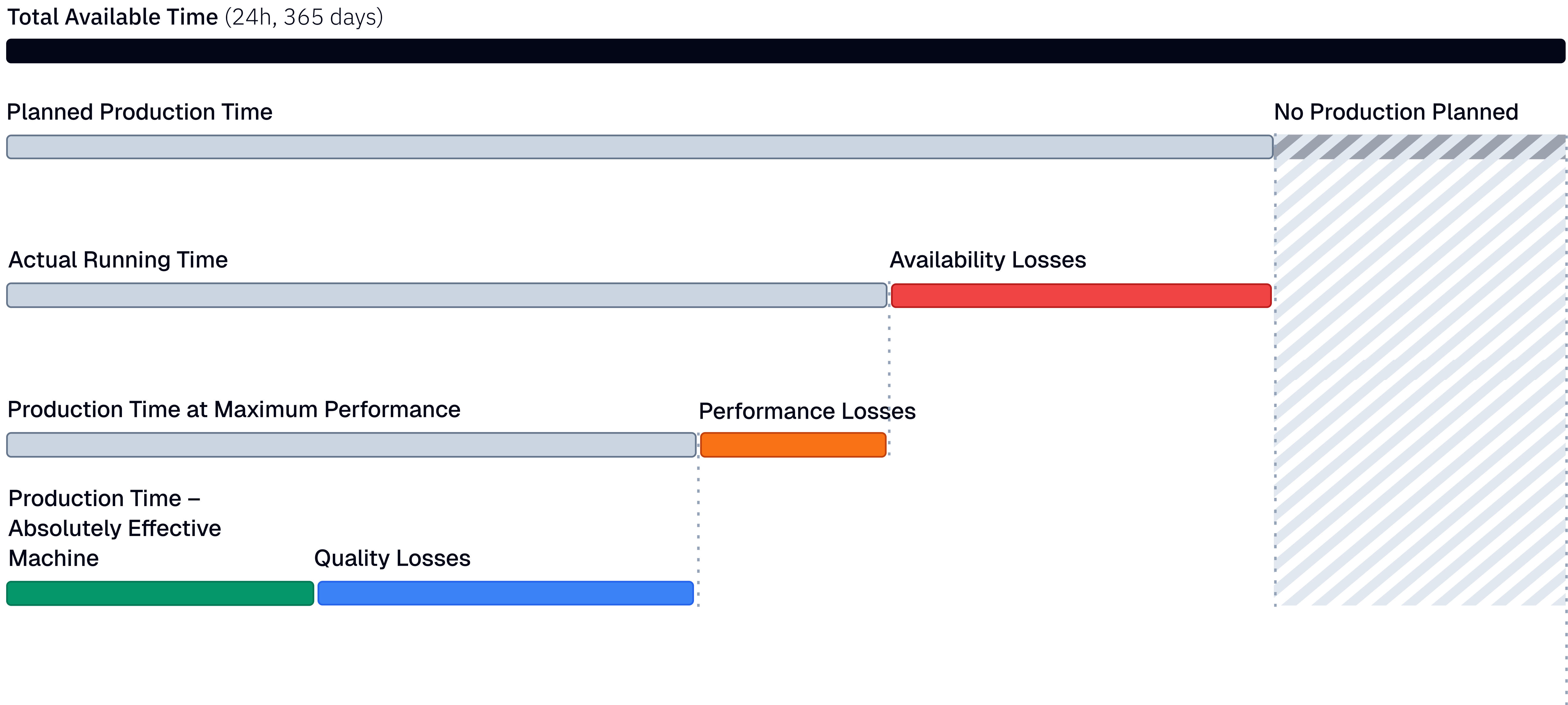
The OEE calculation starts with the observation period, i.e., the total available production time. From this, the time when no production is planned is subtracted—represented as a gray-hatched area.
Then, the individual types of losses are taken into account step by step:
1. **Availability losses** – due to downtimes
2. **Performance losses** – due to slow operation
3. **Quality losses** – due to scrap
The result is the production time that a **perfectly effective machine** would have needed to produce the same amount of good material.
### **Time-Based OEE Calculation**
The simplest formula for calculating OEE is:
$$
\text{OEE} = \frac{\text{Production time perfectly effective machine}}{\text{Planned operating time}}
$$
So, an OEE of 50% means that a perfectly effective machine would have needed only half the time to produce the same amount of good parts.
### **Loss-Based OEE Calculation**
More transparency into the individual loss types is provided by the classic formula:
$$
\text{OEE} = \text{Availability} \cdot \text{Performance } \cdot \text{Quality}
$$
The major advantage of this representation: all essential types of losses are captured—and it's not possible to compensate for poor quality or frequent downtimes with high speed. A true improvement in OEE requires progress in at least one category without deteriorating in the others.
***
Losses can always be represented from two different perspectives:
* **Absolute**: as concrete time losses (e.g., minutes of downtime)
* **Relative**: as percentage factors (e.g., 90% availability)
If you want to learn more about the three loss categories—availability, performance, and quality—you’ll find further information in our documentation on each respective topic.